









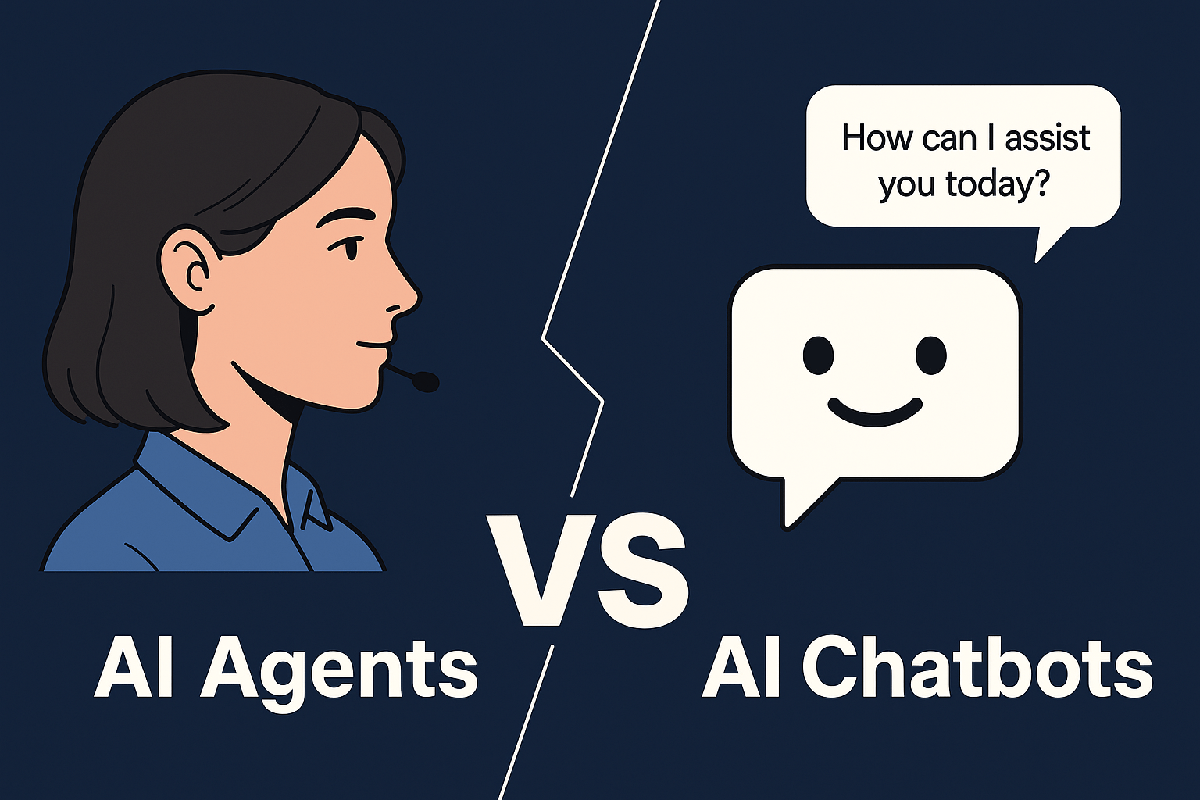
In the rapidly evolving world of digital customer interaction, businesses are no longer simply offering support; they’re delivering experiences. The shift from static, scripted responses toward dynamic, autonomous engagement is reshaping what customers expect and how brands deliver. At OC Digital Firm, we believe that the key differentiator in this new era is the move from chatbots to intelligent AI agents; and the difference makes the title case: AI Agents vs. Chatbots.
In this blog post, we’ll unpack:
- What chatbots are and their role in current customer‑engagement frameworks.
- What AI agents are, how they extend the capabilities of chatbots and why the term “agentic AI” matters.
- A detailed comparison of AI agents vs chatbots (and how to interpret “ai agent vs ai chatbot”).
- The strategic implications of choosing agentic AI platforms vs traditional chatbot builders.
- How to determine when you need an AI agent or AI chatbot, and answer the common question: Is chatbot an AI agent?
- A step‑by‑step roadmap for transitioning from chatbot to AI‑agent driven engagement.
- Five frequently asked questions with answers, so you can guide your stakeholders with clarity.
Our goal: to equip you with insights, practical guidance and strategic frameworks so that OC Digital Firm helps you lead the future of customer engagement rather than simply respond to it.

Understanding Chatbots – The Conversational Foundation
In many organisations, chatbots are still the first line of digital support. They’re effective, familiar, and relatively simple to implement. But to appreciate the leap required in the shift to agentic systems, let’s start with the basics.
What Is a Chatbot?
A chatbot is an application—either text‑based or voice‑based—that interacts with users through conversational interfaces. These systems typically rely on pre‑determined scripts or decision‑trees: the user chooses an option, the bot responds, the flow continues. Chatbots often use keyword matching, intents and entities to parse user input and deliver canned responses.
Typical Use‑Cases for Chatbots
Common scenarios include:
- Answering Frequently‑Asked Questions (e.g., “What are your shipping times?”)
- Guiding users through simple tasks (e.g., resetting passwords, checking order status)
- Collecting basic information (e.g., lead capture forms via conversational UI)
- Handing off to human agents when the query falls outside the scripted scope
Strengths and Limitations of Chatbots
Strengths:
- Cost‑effective for high‑volume, low‑complexity interactions
- Quick deployment compared to full AI or automation projects
- 24/7 availability, providing a digital front door for customers
- Reduces overhead for repetitive, standardized tasks
Limitations:
- Limited context and memory: once the interaction ends, the bot often forgets what happened earlier
- Rigid conversational structure: when users deviate from the script, the bot struggles
- Lack of system integration: many chatbots can’t connect with backend systems to execute tasks
- No proactive capability: chatbots wait for the input—they don’t take initiative
- In short, if you compare agentic AI platforms vs traditional chatbot builders, chatbots fall into the latter bucket: good for structure, poor for autonomy
Thus, while chatbots remain valuable, they serve as a starting point; not the destination—for future‑oriented customer engagement.

What Are AI Agents? The Evolution of Digital Interaction
If chatbots are conversation tools, AI agents are conversation + action tools. They elevate the interaction into an intelligent workflow.
Defining the AI Agent
An AI agent is a software entity designed to observe, decide and act in an environment to achieve particular objectives; while interacting with humans and other systems. In customer engagement, an agent doesn’t just answer questions; it takes action on behalf of the user, coordinates systems, remembers context, and can initiate processes without immediate human prompts.
In the realm of “agentic AI vs chatbot”, the term “agentic” emphasises autonomy, goal‑orientation and system integration. When you hear ai agent vs ai chatbot, remember: the agent is built to act—and do more—than the chatbot.
Core Capabilities of AI Agents
- Contextual memory: An AI agent retains interaction history, relevant customer data and context to tailor future engagements.
- Proactivity: It can anticipate needs or issues and initiate action (e.g., notifying a customer about a subscription renewal).
- Workflow orchestration: Unlike standalone chatbots, AI agents integrate with systems like CRM, ticketing, billing, shipping—and execute tasks across them.
- Learning and adaptation: Over time, agents improve their decision‑making based on outcomes, feedback and evolving business logic.
- Autonomy: They can make decisions, escalate matters, take corrective steps or provide personalized recommendations.
In short, where a chatbot responds, an AI agent takes initiative. Where a chatbot guides, an agent leads the process. The shift from simple dialogue to meaningful action is why many organisations view this as the future of engagement.
AI Agents vs Chatbots – Side‑by‑Side Comparison
To make things concrete: here’s how to evaluate AI agent or AI chatbot for your business.
| Feature | Chatbot | AI Agent |
| Interaction style | Scripted, user‑initiated | Conversational, adaptive, system‑aware |
| Task complexity | Simple, single‑step | Multi‑step, goal‑oriented, cross‑system |
| System integration | Limited or none | Deep integration with CRM, ERP, support systems |
| Memory / context | Stateless or very short history | Persistent memory across sessions |
| Initiative | Reactive only | Both reactive and proactive |
| Personalization | Basic (templates) | Advanced (customised based on behaviour & history) |
| Scalability and evolution | Static workflow updates required | Learns and evolves dynamically |
This table highlights the core disparity: chatbots excel in scripted simplicity. AGENTS excel in intelligent complexity. If your goal is only to manage FAQs, a chatbot may suffice. But if you’re aiming for richer, integrated, and proactive engagement, you’re entering the domain of agentic AI.
Agentic AI Platforms vs Traditional Chatbot Builders
The debate between agentic ai platforms vs traditional chatbot builders is not merely technical—it’s strategic. Let’s unpack what that means for your business.
Traditional Chatbot Builders
These platforms typically offer drag‑and‑drop UI, rule‑based workflows, simple integrations and basic analytics. They are easy to set up, lower cost and require minimal technical overhead—but they also have clear limitations:
- Workflow updates must be manually configured
- Limited support for memory/context or proactive actions
- Integration with backend systems is often superficial or absent
- Analytics tend to focus on chat volumes and response times—not outcome or business impact
Agentic AI Platforms
In contrast, agentic platforms are built to support:
- Autonomy: Agents can trigger actions, not just reply to messages.
- Memory and long‑term context: Retaining interactions and using them to personalize future engagement.
- Deep system orchestration: Tightly coupling with CRM, billing, product systems, logistics, etc.
- Learning loops: Feedback, outcome tracking and adaptation.
- Strategic value: Measurement of business outcomes (e.g., upsell conversion, churn reduction) rather than simply chat metrics.
From an investment perspective, agentic platforms cost more, demand stronger data/IT infrastructure and require governance. But the long‑term payoff is strategic advantage. Whereas chatbot builders deliver incremental improvements, agentic platforms enable transformational change.
Why Agentic AI Is the Future of Customer Engagement
The transition from chatbots to agents reflects deeper shifts in customer expectations, business operations and technology economics.
Changing Customer Expectations
Today’s consumers don’t want to repeat their details, navigate menus or wait for a human to pick up. They expect:
- Continuity: Conversations that span channels, devices and time.
- Personalisation: Recommendations that reflect their history, preferences and context.
- Proactivity: Solutions, not just answers—such as “We’ve noticed your subscription is expiring; would you like to renew?”
When you compare ai agent vs ai chatbot, agents meet these expectations; chatbots often struggle.
Efficiency Gains and Operational Impact
By automating multi‑system workflows with minimal human intervention, AI agents deliver:
- Reduced human agent burden for routine and complex tasks alike
- Faster issue resolution and fewer escalations
- Higher agent productivity and focus on high‑value activities
- Better scalability and adaptability as your business grows
Personalisation at Scale
With memory, context and orchestration, AI agents provide a level of personalization previously reserved for high‑touch human service. For example:
- Recognising returning customers and tailoring offers accordingly
- Suggesting next‑best‑actions in the customer journey
- Handling exceptions seamlessly by collaborating with backend systems
Competitive Differentiation and Future‑proofing
In many markets, product differentiation is minimal. Service and experience become the battleground. Organisations leveraging agentic AI gain:
- Early‑mover advantage in customer engagement
- Ability to streamline service delivery across functions
- Agility to adapt to changing workflows, channels and customer behaviours
Furthermore, choosing agentic architecture means you’re building for tomorrow’s demands—not simply patching yesterday’s bots. In that sense, the question “Is chatbot an AI agent?” reveals the strategic risk of relying solely on chatbots when the future is agentic.
How to Transition from Chatbots to AI Agents
For businesses working with OC Digital Firm, the key is to move thoughtfully, avoiding hype and focusing on value. Here’s a six‑step roadmap.
Step 1: Audit Your Current Conversational Architecture
- Map your existing chatbot workflows: what do they cover, what’s missing?
- Identify customer pain points: where do bots fail, where do humans intervene?
- Examine backend systems: CRM, ticketing, billing—are they integrated or siloed?
- Determine data readiness: Is customer context captured and accessible?
Step 2: Define Agentic Use‑Cases
Prioritise scenarios that:
- Have significant customer value (e.g., onboarding, returns processing, subscription management)
- Span multiple systems or require multi‑step workflows
- Include opportunities for personalization, proactive actions or automation
- Have measurable business outcomes (e.g., reduced resolution time, higher satisfaction, lower cost)
Step 3: Ensure Infrastructure and Data Readiness
Before diving into an agentic platform, confirm:
- APIs are available and exposed for systems (CRM, ERP, support)
- Customer data is clean, unified and accessible
- Governance, security and compliance frameworks are in place
- Internal teams (IT, data engineering, customer service) understand the shift
Step 4: Choose the Right Platform
When comparing agentic AI platforms vs traditional chatbot builders, ask:
- Does the platform support memory and context across sessions?
- Can it connect to your backend systems and orchestrate tasks?
- How much customization and learning does it allow?
- What human‑in‑the‑loop controls and audit trails exist?
- What success stories or use‑cases has the vendor executed?
Step 5: Pilot, Measure and Iterate
- Select a controlled pilot scope—non‑critical yet revealing.
- Define KPIs: customer satisfaction, task completion, automation rate, cost per contact.
- Monitor not just chat metrics but business outcomes (e.g., decrease in human agent hand‑offs).
- Use feedback loops to refine the agent’s memory, orchestration and user experience.
Step 6: Scale with Governance
- Introduce governance frameworks: human oversight, escalation paths, audit logs.
- Expand agent capabilities gradually—adding channels, workflows, integrations.
- Train human agents to work alongside AI agents—shifting roles from first‑response to exception‑handler.
- Continuously monitor for bias, error patterns, customer complaints and escalate improvements.
By following this roadmap, you avoid common pitfalls, optimise ROI and ensure your transition from AI agent or AI chatbot is strategically aligned.
Common Misconceptions About Chatbots and AI Agents
In deploying these technologies, organisations often hold false assumptions. Here are some common myths.
Myth 1: “A Chatbot and an AI Agent Are Basically The Same”
While they share conversational elements, the difference lies in autonomy, integration and capability. A chatbot is essentially a reactive responder, while an agent is an autonomous actor.
Myth 2: “Once We Have AI Agents, Chatbots Will Disappear”
That’s unlikely. Chatbots continue to serve high‑volume, low‑complexity interactions effectively. The evolution is about layering agents where value is highest—not simply replacing everything.
Myth 3: “Implementing AI Agents Means No Humans Are Required”
In fact, humans remain critical—especially for empathy, exception handling, strategy and oversight. AI agents augment humans; they don’t fully replace them.
Myth 4: “AI Agents Are Too Risky, So We Should Avoid Them”
Certainly, there is risk: autonomy, integration, data exposure. But with proper design—human‑in‑the‑loop, audit trails, clear fallbacks—organisations can reap benefits while managing risk.
Myth 5: “Chatbots Are Outdated, We Should Skip Straight to Agents”
While tempting, skipping chatbot adoption may cause you to miss foundational lessons. Starting with chatbots helps organisations build conversational literacy, data pipelines and user experience design before scaling to agents.
By recognising these misconceptions, you’re better prepared to make informed decisions on when to deploy chatbots, when to adopt agents—and how to integrate both.
The Role of OC Digital Firm in Your Agentic AI Journey
At OC Digital Firm, our mission is to support your transition from traditional customer engagement to intelligent, future‑ready interaction. Here’s how we partner with you:
- Strategy and Roadmap Development: We assess your current environment (chatbots, data, systems), define agentic use cases and build a phased roadmap tailored to your organisation.
- Platform Selection and Evaluation: We help you compare vendors, evaluate technical fit, review case studies and structure pilot programs.
- Data and Integration Planning: We collaborate across your IT, data and service teams to ready your systems for agentic deployment—ensuring APIs, customer views and governance are aligned.
- Pilot Implementation and Scaling Support: We manage the pilot lifecycle—launching, tracking KPIs, refining workflows, and preparing for broader rollout.
- Governance and Risk Management: With deeper system access, AI agents require robust controls. We assist in human‑in‑the‑loop design, audit logs, escalation workflows and compliance.
- Change Management & Training: We prepare your teams—customer support, analytics, operations—to work seamlessly alongside AI agents, redefining roles to focus on value‑adding activities.
- Continuous Optimization: As your agents learn and evolve, we support ongoing improvement cycles—refining chat flows, memory modules, orchestration logic and outcome measurement.
By working with OC Digital Firm, you’re not just implementing technology—you’re building a strategic advantage in customer engagement, rooted in intelligent automation and experience.
FAQ About AI Agents vs Chatbots
Here are five commonly asked questions about AI agents vs chatbots, with clear answers to help you align stakeholders and shape decisions.
Q1: WHAT EXACTLY IS THE DIFFERENCE BETWEEN AN AI AGENT AND A CHATBOT?
An AI agent is designed to think, act and learn—it coordinates workflows, remembers context, integrates with systems and can initiate tasks. A chatbot is primarily reactive—responding to user input via scripted logic and offering no real autonomy. The distinction shows up clearly when you compare “ai agent vs ai chatbot”.
Q2: CAN MY EXISTING CHATBOT Evolve INTO AN AI AGENT?
Yes—in many cases your chatbot platform can be upgraded or extended with memory, system integration and orchestration features, transforming it into an agent‑style capability. This is the transition from “chatbot builder” to “agentic AI platform”. However, this often requires new architecture, data readiness, governance and change management.
Q3: IS CHATBOT AN AI AGENT?
Short answer: not typically. Unless the chatbot supports autonomous actions, memory/context and workflow orchestration, it does not meet the definition of an AI agent. That’s why the question “Is chatbot an AI agent” is so important—clarifying this helps avoid misinvestment.
Q4: ARE AI AGENTS ONLY FOR LARGE ENTERPRISES?
Not at all. While large organisations may have more complex use‑cases, many mid‑sized businesses can deploy AI agents effectively—starting with manageable workflows like onboarding, subscription renewals or service issue resolution. The key is to choose high‑impact, manageable pilots and scale thoughtfully.
Q5: HOW DO I DECIDE BETWEEN AN AI agent or AI chatbot FOR MY BUSINESS?
Start by assessing your business needs:
- If your needs revolve around simple, high‑volume queries: a chatbot might suffice.
- If you require multi‑step workflows, system integration, personalization and proactive outreach: you’re looking at an AI agent.
Define your goals, evaluate the “agentic AI platforms vs traditional chatbot builders”, assess your data/systems readiness and pilot accordingly.
Conclusion on AI Agents vs Chatbots
The conversation around AI Agents vs. Chatbots is more than semantics—it’s about how businesses engage customers in a digital‑first world. At OC Digital Firm, we believe that the future lies in systems that don’t just respond—they anticipate, act and learn.
While chatbots provide reliable support for structured tasks, the rise of modern customer expectations demands something more. That “something more” is agentic AI: systems that deliver personalized engagement, automate workflows, integrate across platforms and deliver business outcomes.
By choosing to evaluate agentic AI rather than simply upgrading your chatbot, you’re preparing for future‑proof customer experiences—not just meeting today’s requirements. The path from “ai agent vs ai chatbot” is not just about technology—it’s about strategic advantage, operational efficiency and customer loyalty.
If you’re ready to embark on that journey—and ready to partner with a team that guides you from roadmap to rollout—we at OC Digital Firm are here to help. Let’s build the future of your customer engagement, together.