









If you own a small business, you have probably heard the same promise a hundred times: artificial intelligence will transform your marketing overnight. And if you have actually tried to use it, you have probably also felt the gap between that promise and your Tuesday-night reality, staring at a blank caption box, a content calendar you keep meaning to fill, and a nagging sense that everyone else has figured this out but you.
Here is the honest version. AI in social media is not magic, and it will not run your marketing for you while you sleep. But used well, AI in social media marketing is one of the most practical, budget-friendly advantages a small business can hand itself in 2026. It closes the gap between what a one-person or five-person team can produce and what a much larger competitor produces, and it does that without a bigger payroll.
At OC Digital Firm, we work with small and mid-sized businesses across Orange County, and we spend a lot of our week separating what AI genuinely does from what it is marketed to do. This guide is that separation, written plainly. We will cover what AI in social media actually means, what it does for a small business day to day, what it still cannot do, how to start without wasting money, and how to keep it trustworthy and on brand. No hype, just the working version.
What “AI in Social Media” Actually Means in 2026
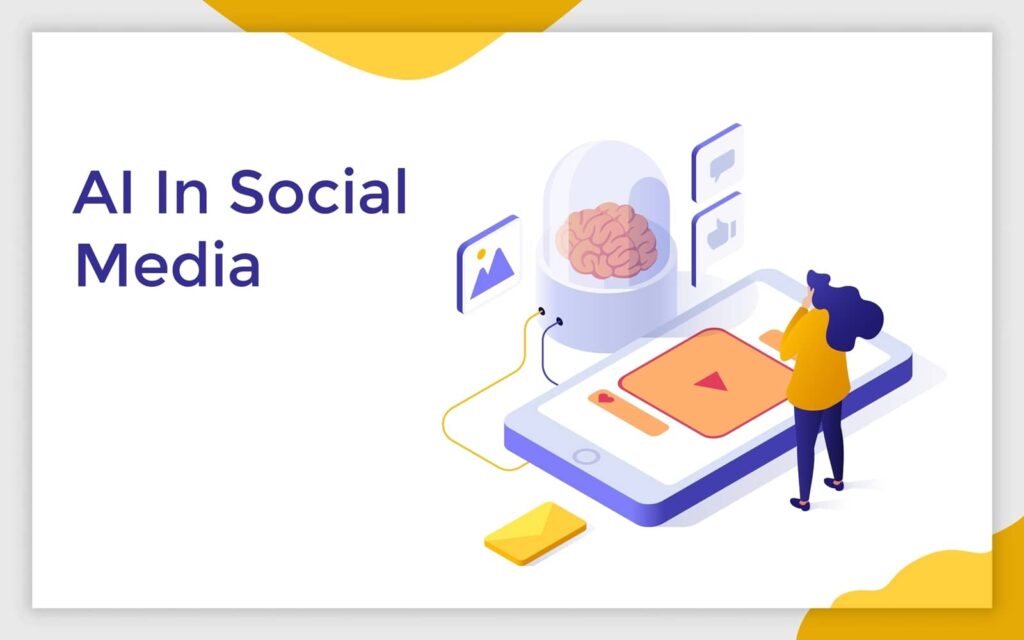
The phrase gets thrown around as if it describes a single product. It does not. When people talk about AI in social media, they are really describing a bundle of different technologies that each handle a different job. Understanding the categories is the first step to using any of them well.
Broadly, artificial intelligence in social media shows up in four forms:
- Generative AI, the tools that write captions, draft posts, brainstorm hooks, and produce images or video variations. This is the category most small business owners think of first, because it is the one they can touch immediately.
- Predictive analytics and machine learning, the quieter engines inside the platforms themselves. These systems decide who sees your post, forecast the best time to publish, and predict which piece of content is likely to perform.
- Social media automation, the scheduling, auto-publishing, routing, and workflow tools that remove the repetitive manual steps from posting and responding.
- Analysis and listening, the sentiment analysis, social listening, and reporting tools that read thousands of comments or mentions and tell you what people actually think about your brand.
The Difference Between AI Hype and AI You Can Use Today
A useful filter: if a tool promises “fully automated growth” or “set it and forget it” results, treat it with suspicion. The version of AI in social media that reliably works for small businesses is assistive, not autonomous. It accelerates the work you already understand. It does not replace your judgment about what your business should say.
That distinction matters because it changes how you buy. You are not shopping for a robot marketer. You are shopping for tools that make you faster: an AI social media assistant that turns one idea into ten posts, an analytics layer that tells you which of those posts to double down on, and an automation system so you are not logging into five apps a day. When you frame AI in social media marketing this way, the decisions get a lot simpler.

Why AI in Social Media Marketing Matters for Small Businesses
Adoption is no longer a fringe experiment. In 2026, Forbes reported that a majority of small businesses already use AI marketing tools, with a large additional share planning to adopt within the year, putting the technology on track to reach roughly four in five small firms. Generative AI use among small businesses climbed from about 40% in 2024 to nearly 60% in 2025, according to figures from the U.S. Chamber of Commerce. Marketing, and social media content specifically, is consistently the first place small businesses put AI to work.
There is a straightforward reason for that. Social media is where the customers are. Pew Research Center’s data on social media use shows that YouTube and Facebook remain the most widely used platforms among U.S. adults, that about half of adults use Instagram, and that meaningful shares use TikTok, Reddit, Snapchat, and X. In other words, your audience is spread across several platforms and expects a steady presence on the ones they favor. Maintaining that presence by hand is a genuine burden for a small team, and it is exactly the burden AI in social media is good at lifting.
The benefits that matter most to a small business owner tend to be practical rather than glamorous:
- Time recovered. Industry research in 2026 puts the average time saved from AI tools at roughly five to six hours a week for a typical small business worker, and higher for owners who produce a lot of content. For a small team, those hours are the difference between posting sporadically and posting consistently.
- Consistency without burnout. AI-assisted content creation lets you build a genuine content pipeline instead of scrambling for something to post.
- A leveled playing field. Consumer-grade AI social media tools now give a solo operator access to capabilities that used to require a marketing department.
- Faster learning. AI-driven analytics shorten the loop between “we tried something” and “here is what worked,” so you improve week over week instead of quarter over quarter.
That last point is the underrated one. The real edge from AI in social media marketing is not any single post. It is the speed at which a small business can test, learn, and adjust. If you want the strategic layer that sits on top of these tools, our guide to building a social media marketing strategy walks through how to point all of this at real business goals.
What AI Actually Does for Your Social Media
This is the section most guides skip, so let us be concrete. Here is what AI in social media does across the actual jobs a small business needs done.
Content Creation and Ideation
This is the most common entry point, and for good reason. Generative AI is genuinely useful for beating the blank page. In practice, AI content creation for social media covers:
- Caption drafting, turning a rough idea, a product detail, or a photo into a first-draft caption you can refine in your own voice.
- Idea generation, producing a month of post concepts from a single prompt about your business, so your content calendar is never empty.
- Repurposing, taking one asset such as a blog post, a customer review, or a short video and reshaping it into a carousel, a Reel script, a Story, and a LinkedIn post.
- Hooks and variations, generating five or ten different opening lines so you can test which one earns attention.
The key phrase is “first draft.” The businesses that get the most from AI in social media treat generated copy as raw material, then edit it into something that sounds like a real person who runs a real business. The ones that get burned are the ones that copy and paste without reading.
Scheduling, Publishing, and Social Media Automation
Once you have content, AI helps you get it out the door with far less friction. Social media automation tools now use machine learning to:
- Recommend the best times to post based on when your audience is actually active.
- Auto-schedule and publish across multiple platforms from one dashboard.
- Reformat a single post to fit the dimensions and conventions of each platform.
- Queue and space content so your feed stays active even during a busy stretch.
For a small business, this is where AI in social media quietly earns its keep. It removes the dozens of tiny manual steps that make consistent posting feel impossible.
Social Listening and Audience Insights
Some of the most valuable AI in social media has nothing to do with content and everything to do with listening. Social listening tools use natural language processing to scan mentions, comments, hashtags, and reviews at a scale no human could match. They can tell you:
- What people are saying about your brand, your competitors, and your category.
- Whether sentiment is trending positive or negative, and why.
- Which topics your audience cares about right now, so your content stays relevant.
- Emerging complaints or questions before they become a pattern.
For an Orange County business trying to understand a specific local market, this kind of AI-powered audience insight turns guesswork into direction.
Community Management and Customer Service
A large share of social media work is simply responding, to comments, direct messages, and questions. AI chatbots and automated response tools help small businesses keep up:
- Answering common questions such as hours, pricing, and availability instantly, even after closing time.
- Routing complex messages to a human instead of letting them sit unanswered.
- Drafting reply suggestions a team member can approve in a click.
Used carefully, this keeps response times fast, which platforms reward and customers notice. Used carelessly, it produces stiff, robotic replies that damage trust. The line between the two is human oversight, which we will come back to.
Ad Targeting and Creative Testing
Paid social is where AI has quietly been doing the heavy lifting for years. The ad platforms inside Meta, TikTok, and others run on machine learning that optimizes delivery, audience targeting, and budget allocation in real time. On top of that, generative AI now helps small businesses:
- Produce multiple ad creative variations quickly, so you can test more angles for the same spend.
- Write and rewrite ad copy tuned to different audiences.
- Identify which creative is fatiguing and needs to be refreshed.
For a small business running a modest ad budget, this testing velocity is one of the most measurable returns on AI in social media marketing. It is also a natural fit with commerce features, which we cover in our breakdown of selling on Instagram.
Analytics and Performance Reporting
Finally, AI turns the mountain of platform data into something a busy owner can act on. Instead of exporting spreadsheets, AI-driven analytics can:
- Summarize performance in plain language, such as “Reels drove most of your reach this month.”
- Flag which content types, topics, and formats are working.
- Forecast likely results so you can plan rather than react.
Put all six of these together and you can see why AI in social media is not one tool but an entire assistive layer sitting underneath a modern small business marketing operation.
What AI Cannot Do (and Why the Human Still Wins)
Being honest about the limits is what separates useful advice from marketing copy. There are real things AI in social media cannot do, and pretending otherwise is how small businesses waste money.
- It does not know your brand voice until you teach it. Out of the box, generative AI produces competent, generic, slightly hollow content. The distinctive voice that makes customers choose you comes from a human who knows the business.
- It does not have judgment. AI cannot tell you whether a trend fits your brand, whether a joke will land with your specific customers, or whether now is the wrong moment to post something lighthearted. That is strategy, and strategy is human.
- It does not build relationships. A real reply from a real owner to a loyal customer is worth more than a hundred automated ones. AI can help you keep up. It cannot care.
- It does not understand your local market the way you do. The nuances of a Newport Beach clientele versus a Costa Mesa one, the seasonality of your industry, and the regulars who keep you in business, all of that context lives with you.
- It gets things wrong. Generative AI can produce confident, plausible, and completely inaccurate statements. Anything it drafts about your prices, your policies, or factual claims needs a human check before it goes live.
The takeaway is not “avoid AI.” It is that AI in social media marketing works best as an amplifier of human skill, not a replacement for it. The small businesses winning with AI in 2026 are the ones using it for speed, scale, and data, while keeping a human firmly in charge of voice, judgment, and relationships.
How a Small Business Can Start Using AI in Social Media
You do not need a big budget or a technical background to start. You need a sensible sequence. Here is the roadmap we recommend to the businesses we work with.
- Audit what is eating your time. Before buying anything, write down where your social media hours actually go. Caption writing? Scheduling? Answering DMs? Reporting? The biggest time sink is where AI will pay off first.
- Pick one or two use cases, not ten. The fastest way to fail is to adopt everything at once. Choose the one or two applications of AI in social media that map directly to your biggest time sink. For most small businesses, that is content creation and scheduling.
- Choose tools that fit your workflow. You likely do not need a separate tool for every job. Many social media management platforms now bundle AI content creation, scheduling, and analytics together. Favor an integrated tool over a drawer full of single-purpose apps.
- Set your guardrails first. Decide, up front, what AI is allowed to do on its own, such as drafting captions and suggesting post times, and what always requires human approval, such as anything published and anything a customer sees. Write it down so it survives a busy week.
- Build a review habit. Every piece of AI-assisted content gets a human pass for accuracy, tone, and brand fit before it publishes. This single habit prevents most of the ways AI in social media goes wrong.
- Measure, then expand. Give your first use case a month. Did it save time? Did quality hold up? If yes, add the next use case. This gradual approach keeps you in control and keeps costs tied to real results.
Start narrow, prove the value, and grow from there. That disciplined path beats chasing every new AI social media tool that lands in your feed. To see where this is all heading, our look at social media trends for 2026 puts these use cases in context.
Getting AI-Assisted Social Media Right: Trust, Disclosure, and Brand Safety
This is the part of AI in social media that gets the least attention and matters the most for a small business, because your reputation is the whole game. A few areas deserve real care.
Accuracy is on you, not the AI. Because generative tools can state false things with total confidence, every factual claim, price, promotion, or product detail in AI-drafted content needs to be verified by a human. One inaccurate post can cost more trust than a month of good ones earns.
Disclosure and endorsement rules apply. As AI-generated content and AI-assisted endorsements become common, transparency is not optional. The Federal Trade Commission’s guidance on endorsements, influencers, and reviews makes clear that the same consumer-protection standards apply regardless of how content is produced. If a testimonial, review, or endorsement is involved, material connections must be disclosed clearly, and AI does not change that obligation. For a small business, the safe rule is simple: never let AI generate content that could mislead a customer about who is speaking or what relationship exists.
Avoid the “AI slop” trap. Audiences and platforms are increasingly good at spotting bland, mass-produced, obviously automated content. Generic AI social media posts do not just underperform. They can make a brand look lazy. The fix is human editing and a real point of view, the things that make content feel like it came from an actual business.
Protect data and privacy. Be thoughtful about what customer information you feed into AI tools. Use reputable platforms, read the terms, and avoid entering sensitive customer data into systems you do not control.
Keep a human in the loop for anything customer-facing. Automated replies are fine for routine questions. Complaints, sensitive situations, and anything with nuance should reach a person. Speed matters, but a wrong automated response in a delicate moment is worse than a slightly slower human one.
Handled this way, AI in social media marketing strengthens trust rather than eroding it, which, for a small business, is the entire point.
The Real ROI of AI in Social Media for Small Businesses
When owners ask us whether AI in social media is “worth it,” they are usually picturing a single dramatic result. The real return is quieter and more compounding.
- Reclaimed time that an owner can spend on the parts of the business only they can do.
- Consistency, which is the single biggest driver of social media results and the hardest thing for a small team to sustain by hand.
- Testing velocity, the ability to try more ideas, more captions, and more ad angles for the same budget, and to learn faster from each.
- Better decisions, because AI-driven analytics turn raw platform data into direction.
- More qualified attention, which is what social media is supposed to produce in the first place: awareness that turns into leads and customers.
Notice that none of these depend on AI being a genius. They depend on it being a reliable assistant that makes a small team behave like a bigger one. That is the honest ROI of AI in social media marketing in 2026. Not a miracle, but a durable, cost-effective advantage for the businesses disciplined enough to use it well.
How OC Digital Firm Helps Orange County Businesses Use AI in Social Media
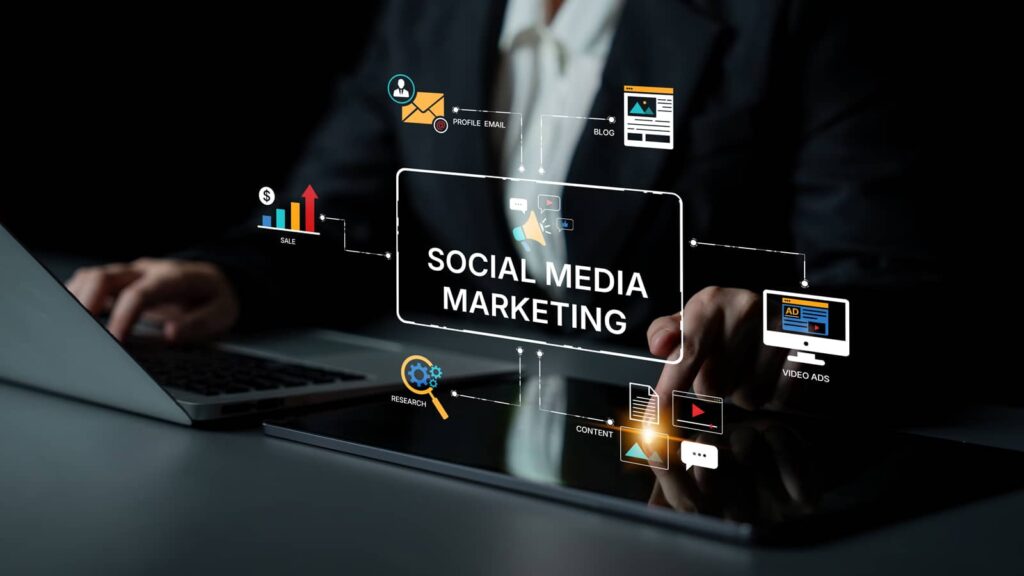
We are a digital marketing agency based in Irvine, working with businesses across Orange County, from Newport Beach and Costa Mesa to Mission Viejo and Santa Ana. Our approach to AI in social media is the same one described throughout this guide: use the technology for speed, scale, and insight, and keep experienced humans in charge of strategy, voice, and the relationships that actually grow a business.
For small business owners, that usually means we handle the heavy lifting. We build an AI-assisted content pipeline, run and test paid social, listen to your market, and report on what is working, while making sure everything that reaches your customers is accurate, on brand, and genuinely yours. The goal is never to sound like a machine. It is to give your business the output of a full marketing team without the overhead of one. You can see the full scope on our social media marketing services page.
If you want AI in social media marketing that is grounded, honest, and built for how your specific market behaves, that is exactly the kind of work we do every day. Get in touch with OC Digital Firm and we will map out a plan.
Frequently Asked Questions About AI in Social Media
1. What is AI in social media, in simple terms?
AI in social media refers to the range of artificial intelligence tools that help create, schedule, analyze, and manage social media content. In practice that includes generative AI for writing captions and producing images, automation tools for scheduling and publishing, social listening tools that read audience sentiment, chatbots for customer questions, and analytics that turn platform data into recommendations. For a small business, the most useful way to think about it is as an assistive layer that makes a small team faster, not a system that runs your marketing on its own.
2. Is AI in social media marketing worth it for a small business?
For most small businesses, yes, with a caveat. The value comes from time saved, more consistent posting, faster testing, and clearer analytics, which together let a small team compete with much larger ones. The caveat is that the return depends on human oversight. Businesses that treat AI-generated content as a finished product tend to publish generic, sometimes inaccurate posts that hurt more than they help. Businesses that treat AI as a first draft and add their own voice and judgment get a real, cost-effective advantage.
3. Will AI replace social media managers or marketing agencies?
No, but it changes the job. AI in social media handles the repetitive, high-volume work: drafting, scheduling, formatting, and summarizing data. What it cannot do is set strategy, understand a local market, protect a brand’s voice, or build genuine customer relationships. The strongest results in 2026 come from pairing AI’s speed with human expertise, which is why skilled marketers and agencies are becoming more valuable, not less. The people at risk are those who only did the tasks AI now automates. The people thriving are those who direct it well.
4. What are the risks of using AI in social media?
The main risks are accuracy, authenticity, disclosure, and privacy. Generative AI can produce confident but false statements, so every factual claim needs a human check. Over-automated content can feel generic and damage brand trust. Endorsement and disclosure rules still apply to AI-assisted content, per FTC guidance, so transparency matters. And you should be careful about feeding sensitive customer data into third-party tools. All of these risks are manageable with a simple rule: keep a human in the loop for anything a customer will see.
5. How does a small business start using AI in social media without wasting money?
Start narrow. Audit where your social media time actually goes, pick one or two use cases that target your biggest time sink, usually content creation and scheduling, and choose an integrated tool rather than a pile of single-purpose apps. Set clear guardrails for what AI can and cannot do on its own, build a habit of human review before anything publishes, and give your first use case a full month before expanding. This gradual, measured approach keeps costs tied to real results and keeps you in control of your brand.